Connected RV app: discovery, design, and development
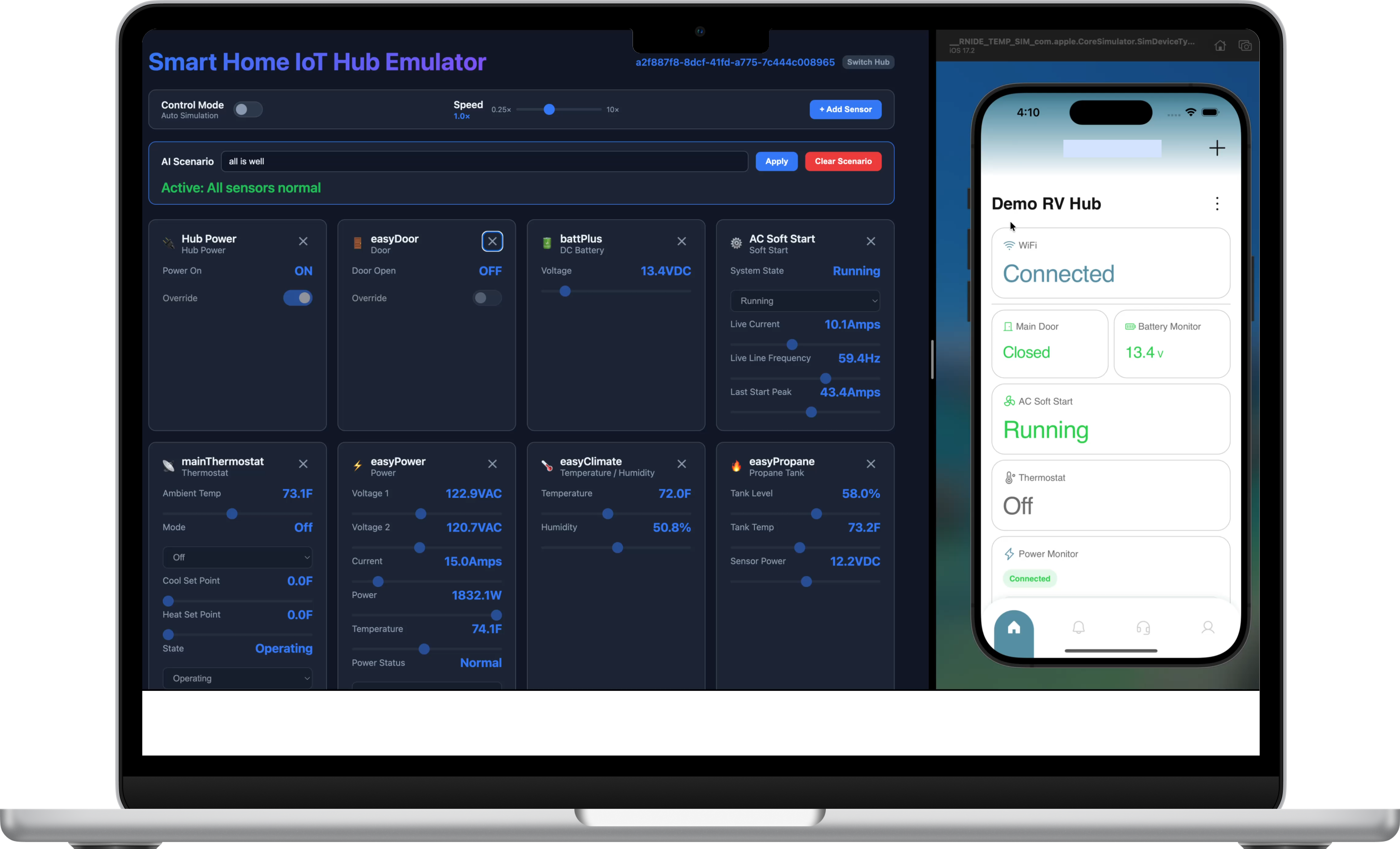

Our client makes connected comfort and power products for RVs. Their hub links an RV's thermostat, air conditioning, battery, propane, doors, and power monitoring. We're building the mobile app that puts all of it in the owner's hand.
One app for every device in the RV
Discovery
We started by mapping every device the hub supports: thermostat, AC soft start, battery, propane, doors, and power monitoring. Working with the client's team, we set which controls owners need first and how the app should behave when a device drops offline.
Design
We designed the app around a single hub dashboard, so owners can read the state of each system at a glance: connection, door, battery voltage, AC, and thermostat. Discovery and design also gave both teams the detail to plan and estimate development with confidence.
Development that doesn't wait on hardware
The hardware problem
In a hardware-first process, app engineers write against spec documents and only meet the real boards near the end. Every test device has to be provisioned, certified, wired, and powered. Board revisions take weeks, and the failures that matter most, like power loss or a dropped Bluetooth connection, are the hardest to recreate safely.
A virtual wireless bench, built with Claude Code
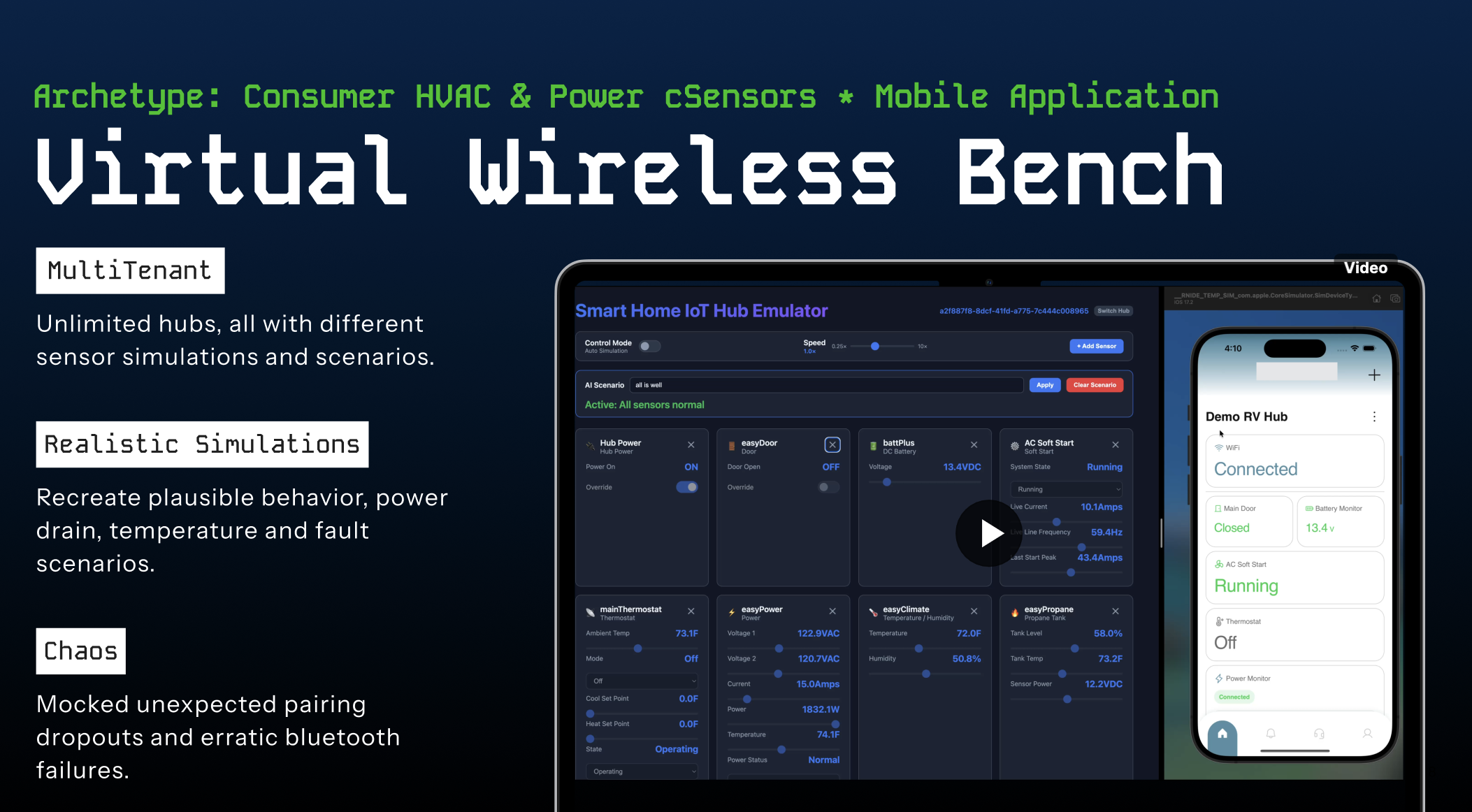
When development started, we used Claude Code to read the hub's hardware schema and generate a virtual version of every device, with matching state, metrics, and interfaces. The bench runs unlimited hubs, each with its own sensors and scenarios. Every developer has a fleet of hubs on their laptop, and anyone on the team can set a scenario in plain English.
Failures tested before the hardware arrives
Map, trigger, validate
Claude Code turns the hardware schema into virtual environments, state metrics, and interface definitions. We trigger anomaly events on the bench: voltage fluctuations, bad sensor readings, pairing dropouts, and erratic Bluetooth. Then we confirm the app handles each failure without lagging, locking up, or crashing.
What it means for the client
App development moves independently of hardware delivery. Edge cases that used to need a lab and a spare board are a scenario the team runs on a laptop, so the app reaches real hardware with its failure handling already tested.
Ready to get started?
We see our clients as our partners and are invested in their success. We ensure what we build for our clients will have a positive ROI. We never build anything just for the sake of it.